

Written by Tim McAllister | Investsments Analyst | Financial Planning
The race to build artificial intelligence infrastructure across the United States is rapidly becoming one of the defining investment themes of the decade. While much of the attention has focused on semiconductor companies and AI software, a quieter but equally important story is unfolding underneath the surface: the enormous demand for energy, industrial materials and commodities required to build and power modern data centres.
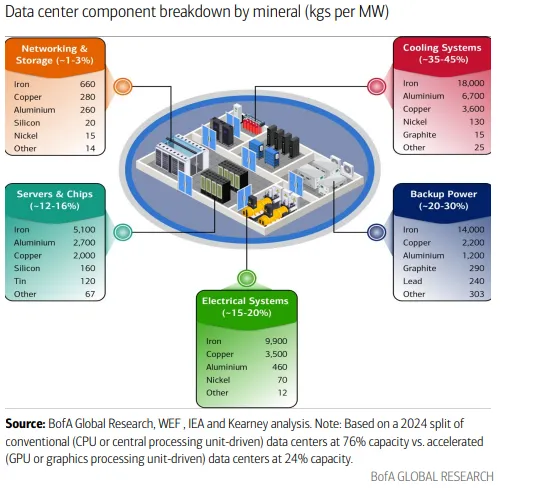
Recent analysis from Bank of America highlights just how resource-intensive these facilities have become. A single large-scale data centre can require tens of thousands of kilograms of metals and minerals per megawatt of capacity. Cooling systems alone account for roughly 35–45% of the mineral footprint, while electrical systems, backup power infrastructure, networking equipment and high-performance servers consume vast quantities of copper, aluminium, iron, nickel, and graphite.
This matters because the AI revolution is no longer just a technology story; it is increasingly becoming a commodity and energy story as well.
The United States is currently experiencing a surge in hyperscale data centre construction as major technology companies invest hundreds of billions of dollars into AI infrastructure. These facilities require immense computing power to train and run advanced AI models, particularly those powered by graphics processing units (GPUs). The resulting electricity demand is extraordinary, with some estimates suggesting US power consumption from data centres could more than double over the coming decade.
That has significant implications for energy markets. Utilities are scrambling to secure reliable baseload generation, while natural gas, nuclear power and renewable energy projects are all seeing renewed investment interest. The pressure on electricity grids is also driving major spending on transmission networks, transformers and backup power systems, all of which require large quantities of industrial metals.
Copper stands out as a critical beneficiary. Often described as the “metal of electrification,” copper is essential for electrical wiring, power distribution and cooling systems. Aluminium demand is also rising due to its use in electrical components and lightweight infrastructure. Meanwhile, nickel and graphite — both heavily associated with battery technologies — are increasingly important for energy storage systems that support grid reliability and backup power.
The strategic importance of these materials is becoming even more pronounced as geopolitics reshape global supply chains. The United States and its allies are actively attempting to reduce dependence on China for critical minerals, advanced manufacturing and semiconductor supply chains. China currently dominates large parts of the processing and refining market for many essential commodities, including rare earths, graphite and battery materials.
This shift toward “friend-shoring” and supply chain diversification is likely to create both risks and opportunities for investors. Governments across North America, Europe and parts of Asia are encouraging domestic production and alternative sourcing strategies for critical resources. That could support long-term investment in mining, processing, energy infrastructure and industrial manufacturing outside China.
For investors, the broader lesson is clear: the AI and data centre boom is not confined to technology stocks alone. The buildout of digital infrastructure has far-reaching economic effects that extend into commodities, utilities, industrials and energy markets globally.
It also reinforces the importance of diversification. In a world where geopolitical tensions, trade disputes and supply chain fragmentation are becoming more common, relying too heavily on a single country or sector can increase portfolio risk. Global diversification across regions, industries and asset classes remains one of the most effective ways to navigate an increasingly complex investment landscape.
The next phase of the AI revolution will require more than algorithms and chips. It will require power stations, transmission lines, cooling systems and enormous volumes of raw materials. Investors who understand these interconnected trends may be better positioned to identify opportunities well beyond the traditional technology sector.
For any further questions or concerns please reach out via our phone number 07 3221 5677 or via email enquiries@walshs.com.au.