

Division 296 is now law. The two Bills implementing it – the Treasury Laws Amendment (Building a Stronger and Fairer Super System) Bill 2026 and its companion Imposition Bill – passed Parliament on 10 March 2026 and received Royal Assent shortly after. The tax commences from 1 July 2026, with the first assessments expected to be issued after 30 June 2027.
If your total superannuation balance is approaching or above $3 million, this update is for you. Below is a summary of how the tax works, who it affects, and what’s worth thinking about before 30 June 2027.
What is Division 296 Tax?
Division 296 is a personal tax – it’s assessed to you as an individual, not to your super fund. It sits on top of the existing 15% tax your fund already pays on its earnings.
It applies where your Total Superannuation Balance (TSB) – the combined value of all your super interests, including any SMSF, industry or retail fund, and defined benefit interests exceed $3 million. For the first year (2026-27), only your balance at 30 June 2027 is tested. From 2027-28 onward, the higher of your opening and closing balance each year will be used.
How is Division 296 Tax Calculated?
The additional tax applies in two tiers, based on your TSB:
| Total Super Balance | Additional Div 296 tax on earnings | Effective combined rate |
|---|---|---|
| Up to $3 million | Not applicable | 15% (standard fund rate) |
| $3 million – $10 million* | Up to 15% | Up to 30% |
| Above $10 million* | Up to 10% | Up to 40% |
*Both thresholds are indexed, the $3 million threshold in $150,000 increments and the $10 million threshold in $500,000 increments.
It’s a proportion of earnings, not the whole balance
Division 296 doesn’t tax your whole balance at the higher rate, and it doesn’t tax your whole year’s earnings either. It only taxes the proportion of your earnings that relates to the part of your balance sitting above $3 million (and above $10 million, where relevant).
Division 296 Tax = (15% * PB1 * Div296 Earnings) + (10% * PB2 * Div296 Earnings)
-
PB1: Portion of TSB greater than $3m =
TSB − $3m
TSB
-
PB2: Proportion of TSB greater than $10m =
TSB − $10m
TSB
What counts as “earnings”?
This is where the final law differs meaningfully from the original 2023 proposal. Unrealised gains are no longer taxed. Division 296 earnings are now based on realised amounts only, think standard investment earnings (interest, dividends, distributions, rent, capital gains etc)
For SMSFs, where there is more than one member, these earnings need to be split between members and reported to the ATO.
Three worked examples
Example 1
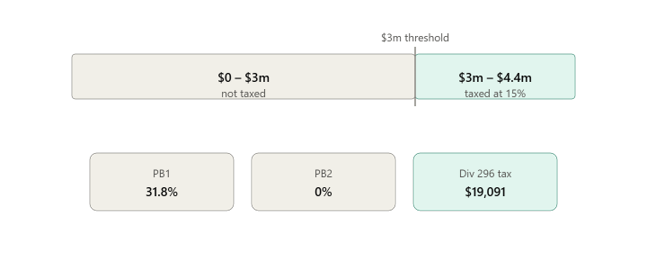
A client’s TSB is $4,000,000 at the start of the year. Over the year the fund had realised earnings equivalent to 10% growth ($400,000) bringing the closing balance to $4,400,000.
Division 296 Tax = (15% * PB1 * Div296 Earnings) + (10% * PB2 * Div296 Earnings)
- PB1 = ($4,400,000 − $3,000,000) ÷ $4,400,000 = 8%
- PB2 = 0% (TSB is under $10m)
- Div296 Tax = (15% × 31.8% × $400,000) + (10% × 0% × $400,000)
- Div296 Tax = $19,091 + $0 = $19,091
This client’s Division 296 liability for the year is $19,091 – on top of the tax their fund already pays (15% if 100% in accumulation phase).
Example 2
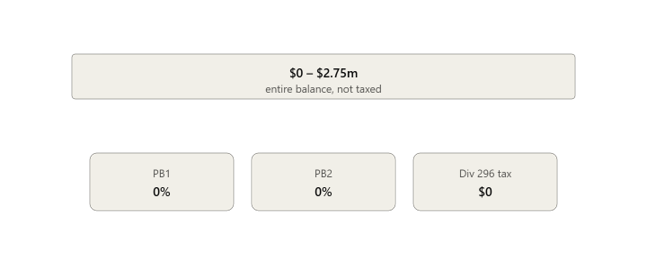
A client’s TSB is $2,500,000, growing to $2,750,000 over the year. Because their TSB stays below $3 million at both the start and end of the year, Division 296 simply doesn’t apply.
Their fund’s earnings continue to be taxed at the standard 15% rate only. No Division 296 assessment is issued, and there’s nothing extra to report or elect.
Example 3
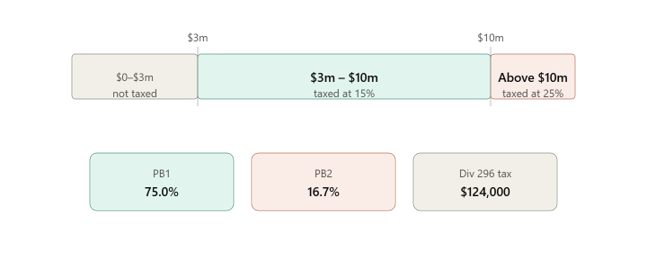
A client’s TSB is $12,000,000 at year end, with $960,000 of realised Division 296 earnings for the year. Because part of the balance sits between $3 million and $10 million, and part sits above $10 million, the earnings need to be split across both tiers:
Division 296 Tax = (15% * PB1 * Div296 Earnings) + (10% * PB2 * Div296 Earnings)
- PB1 = ($12,000,000 − $3,000,000) ÷ $12,000,000 = 75.0%
- PB2 = ($12,000,000 − $10,000,000) ÷ $12,000,000 = 16.7%
- Tax = (15% × 75.0% × $960,000) + (10% × 16.7% × $960,000)
- Tax = $108,000 + $16,000 = $124,000
This client’s Division 296 liability for the year is $124,000 – on top of the tax their fund already pays (15% if 100% in accumulation phase).
How you’ll pay it
The ATO calculates your Division 296 liability, using earnings information reported by your superfunds and issues you a personal notice of assessment. You’ll then have the option to pay the liability personally or have it released from your super fund, similar to the existing Division 293 process.
If your Division 296 earnings are negative in a given year, your assessment is simply nil.
The cost base reset – an important election for SMSFs
Because unrealised gains up to 30 June 2026 are being ignored by Div296, SMSFs can elect to reset the cost base of all fund assets to their market value as at 30 June 2026. This ensures gains that accrued before Division 296 existed aren’t inadvertently captured when assets are eventually sold.
Important points to note
- The election applies to the whole fund, asset by asset selection isn’t available – if some assets are sitting at a loss, those will be reset too
- It must be made by lodging the approved form with your SMSF’s 2026 income tax return (this form doesn’t exist yet)
- It’s only available to SMSFs and other small funds, not standard APRA-regulated accounts
- Whether resetting is worthwhile depends on your fund’s specific asset mix and gain positions – this is something we can model for you individually.
Should you do anything before 30 June 2027?
Not necessarily – and we’d caution against acting prematurely. The first-year transitional rule (testing only your 30 June 2027 balance) provides some flexibility, but withdrawing super to sit under $3 million has its own consequences, including personal or trust-level tax on funds withdrawn, loss of the concessional super environment, and restrictions on recontributing later.
For most clients, the right approach will depend on your age, retirement timeline, asset structure, and how much of your balance sits above the threshold. Worthwhile things to consider with us include:
- Whether the SMSF cost base reset election makes sense for your fund
- Whether assets are better held inside or outside super on an after-tax basis, given your personal marginal rate
- Contribution strategy – including whether it still makes sense to keep growing a balance that’s already above the threshold
- Estate planning implications, since Division 296 can also apply in the year of death where TSB exceeded $3 million