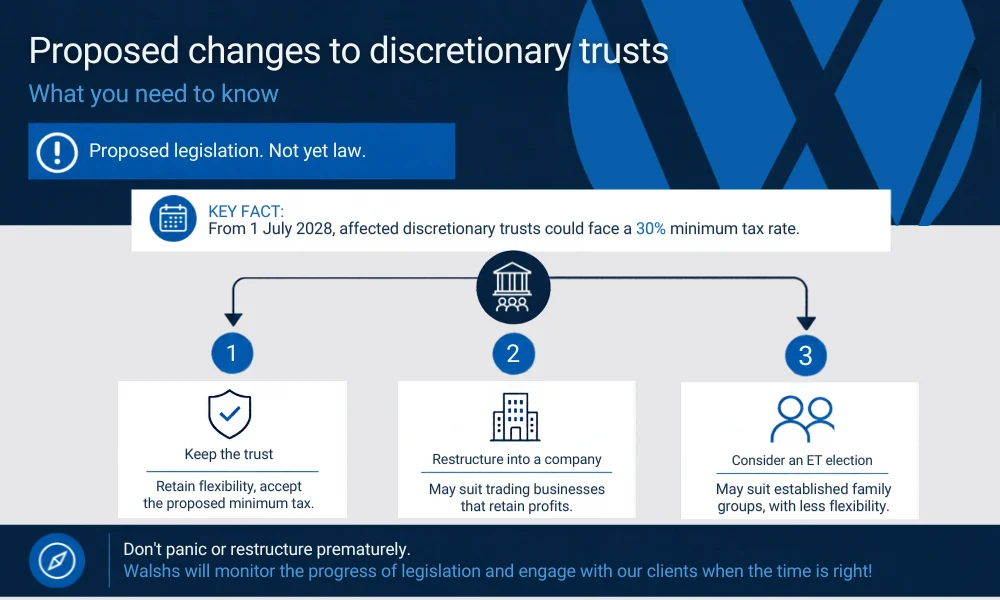
The Federal Government has introduced proposed legislation that could significantly change how discretionary trusts are taxed from 1 July 2028.
Under the proposal, affected discretionary trusts would be subject to a minimum 30% tax on their income, potentially impacting family trusts, small businesses and existing distribution strategies.
Importantly, these changes are not yet law. Walshs does not recommend restructuring solely in response to the proposed changes until the legislation is finalised.
However, trustees and business owners should begin considering how the changes may affect their existing arrangements.
Who Could Be Affected?
The proposed changes may affect families and businesses operating through discretionary trusts, particularly those distributing income to beneficiaries on lower tax rates or corporate beneficiaries, commonly known as bucket companies.
Certain trusts and income, including deceased estates, special disability trusts and primary production income, are expected to be excluded, subject to eligibility requirements.
Understanding the Three Proposed Options
1. Retain Your Existing Discretionary Trust
Trustees may choose to maintain their current structure and accept the proposed 30% minimum tax.
This may remain appropriate where flexibility, asset protection and succession planning are priorities, or where restructuring costs outweigh potential tax savings.
2. Restructure Into a Company
For businesses that regularly retain and reinvest profits, a company structure may become more attractive.
The proposal includes transitional income tax rollover relief from 1 July 2027 to 30 June 2030. However, restructuring may still involve stamp duty, capital gains tax considerations, valuations and professional fees, particularly for Queensland property-owning trusts.
3. Make an Excluded Election Trust (EET) Election
The proposed EET regime may allow eligible trusts to retain their existing structure without being subject to the 30% minimum tax.
However, trustees would need to nominate beneficiaries and commit to fixed distribution proportions, significantly reducing flexibility. Departing from these arrangements could result in the election being revoked and additional tax consequences.
What Should Trustees Do Now?
There is no need to restructure immediately. However, reviewing your existing arrangements can help you prepare for potential changes.
Key considerations include:
- Reviewing existing trust structures and distribution arrangements.
- Identifying bucket company arrangements and potential tax implications.
- Assessing assets, unrealised capital gains and restructuring costs.
- Considering future beneficiaries, asset protection and succession planning.
The most appropriate strategy will depend on your individual circumstances, as there is unlikely to be a one-size-fits-all solution.
Walshs’ Position
Walshs will continue to monitor legislative developments and provide updates as further details become available.
Our recommendation is to avoid premature restructuring decisions and wait until the final legislation is confirmed before determining the most appropriate approach.
Once legislated, our team can assist affected clients in reviewing their trust structures, assessing available options and developing strategies aligned with their financial and business objectives.
Learn more about our specialist taxation and accounting services.
Frequently Asked Questions
What are the proposed discretionary trust tax changes?
The Government has proposed introducing a minimum 30% tax on income earned by affected discretionary trusts, with certain exclusions and alternative arrangements available.
When would the 30% minimum tax commence?
The proposed commencement date is 1 July 2028, subject to legislation passing Parliament.
Should I restructure my family trust now?
Not necessarily. Walshs recommends waiting until the legislation is finalised before making structural changes solely in response to these proposals.
Need Advice?
If you operate through a discretionary trust and would like to understand how the proposed changes may affect you, contact the Walshs Accounting and Taxation team on 07 3221 5677 or enquiries@walshs.com.au.
This information is general in nature and based on proposed legislation as at October 2026. The measures remain subject to change.