

Written by Luke Mackie | Provisional Financial Adviser | Accounting
Australian property prices have risen sharply over recent years, particularly through and following the COVID period. In markets such as Brisbane, Perth and parts of regional Queensland, price growth has exceeded 70% over five years in some areas. This has led many investors, especially high‑income professionals to ask a fair question:
Is investing in property still viable given it is already “expensive” or is investing in shares the new method of wealth creation?
While the concern is understandable, focusing solely on recent price growth misses the deeper forces that drive long‑term property performance. History shows that similar doubts have emerged at almost every stage of the property cycle, yet Australian residential property has continued to grow despite interest‑rate changes, regulatory reforms and global economic shocks.
The more useful question is not whether property is “expensive”, but what drives property prices and whether those drivers remain intact.
Why Australian Property Continues to Grow Over the Long Term
One of the most powerful drivers of property prices in Australia is supply or more accurately, the ongoing shortage of housing. Australia continues to experience a structural undersupply of residential property driven by population growth, migration, rising construction, labour costs, planning and zoning constraints, and the slow delivery of new housing stock.
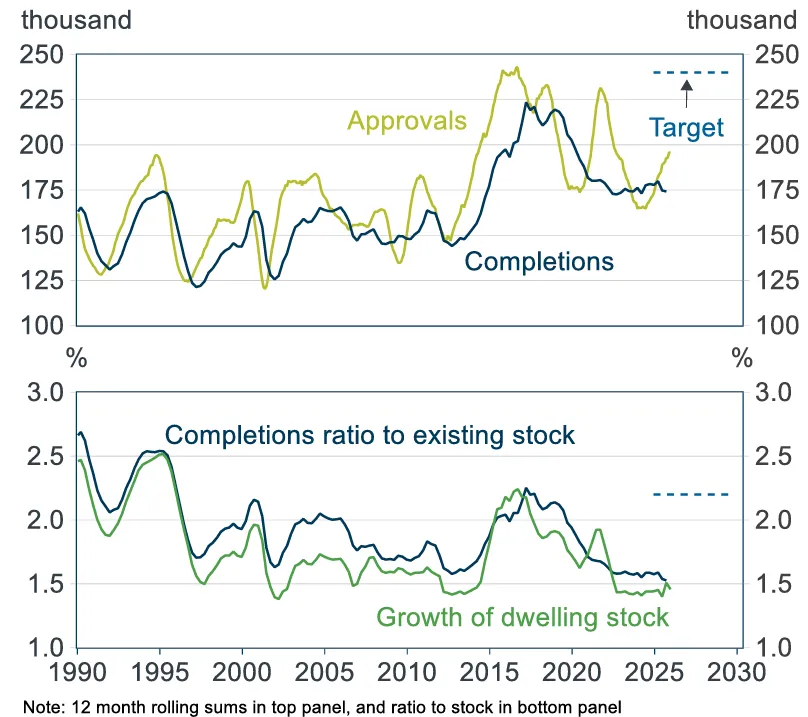
When demand persistently exceeds supply, upward pressure on prices is the logical long‑term outcome. While short‑term corrections and cycles are inevitable, these structural imbalances tend to support property values over time.
This dynamic is particularly evident in South East Queensland, where population growth, lifestyle appeal and infrastructure investment continue to underpin housing demand. With Brisbane’s Olympic‑related development pipeline further reinforces the region’s long‑term economic and housing fundamentals.
Intergenerational Wealth Transfer Is Changing Property Demand
Australia is entering one of the largest intergenerational wealth transfers in its history. As baby boomers age, substantial wealth, largely held in property, superannuation and business assets are progressively transferring to younger generations.
This transfer often arrives as inheritances, early gifts, parental guarantees or assistance with deposits and debt reduction. A significant portion of this capital ultimately flows into residential property, creating demand that is not solely dependent on wage growth.
This helps explain why property prices can continue rising even when wages alone appear insufficient to justify headline values. Over the long term, intergenerational wealth transfer acts as a structural tailwind for well‑located, high‑quality property assets.
Property Prices Are Not Determined by Wages Alone
A common argument against investing in property is that prices must eventually stall because wages cannot keep pace. In practice, property markets particularly in premium and tightly held locations are influenced by far more than local salaries.
Purchasing power is increasingly driven by accumulated wealth, business ownership, dual‑income households and existing asset holders recycling equity. This is why asset selection remains critical.
Long‑established blue‑chip suburbs in Sydney like Paddington, have continued to grow with a median house price of $3.6 million in 2025 despite long exceeding wage‑based affordability metrics. This puts into perspective that many Brisbane and Melbourne suburbs today resemble Sydney price points from one or two decades ago.
The Ripple Effect: How Affordability Drives Growth
As inner‑city locations become less accessible, demand does not disappear; it shifts to neighboring suburbs offering relative affordability and lifestyle appeal. Over time, this displacement leads to gentrification and long‑term capital growth. This can be seen with the drastic rise in house prices in outer ring Brisbane (Redcliffe, Lawnton, Woody Point) once inner-city property was deemed unaffordable by some households.
Property vs Shares: The Role of Leverage
Given all of the above property offers a unique wealth strategy which is advantaged through leverage compared to ownership of shares. Property allows investors to control a large asset with a relatively small amount of capital. For example, all medical professionals are able to acquire investment property with a 5% deposit with no Lenders Mortgage Insurance (LMI), allowing them to benefit from 100% of the asset’s capital growth, despite contributing only a fraction of the purchase price upfront.
By comparison, share investing is typically far less leveraged.
The key difference is what compounds:
- Shares compound only the invested capital
- Property compounds the full asset value
To illustrate this, consider two investors starting with the same $50,000 over a 15year period:
- One uses the capital as a deposit to acquire a $1 million property
- The other invests directly into shares
Even assuming conservative growth rates (5% p.a. for property and 10% p.a. for shares), it can be seen below the stark difference this compounding effect has.
| Item | Leveraged Property | Shares (Unleveraged) |
|---|---|---|
| Starting capital (deposit) | $50,000 | $50,000 |
| Asset controlled | $1,000,000 property | $50,000 portfolio |
| Annual growth rate | 5% p.a. | 10% p.a. |
| Value after 15 years | ~$2.08 million | ~$209,000 |
| Total capital growth | ~$1.08 million | ~$159,000 |
| Holding costs (15 yrs) | -$375,000 | Nil |
| Net wealth created | ~$705,000 | ~$209,000 |
Stamp Duty, Loan Amortisation & rental increases are excluded*
The Bottom Line
Property prices have risen significantly, but that alone does not make property irrelevant as a wealth creation tool.
When used strategically, property still offers:
- Unique access to leverage
- Exposure to long-term supply and demand dynamics
- The ability to compound wealth alongside professional cash flow
The key is ensuring that any property strategy:
- Fits within a broader financial plan
- Is appropriately structured utilising mortgage polices tailored to medical professionals
- Focuses on high-quality assets with strong long-term fundamentals
For many, property remains a valuable component of a well-designed wealth strategy when used alongside shares, not instead of them.
If you would like to explore whether a property-based strategy makes sense as part of your long-term wealth creation either alongside or in comparison to shares, we are happy to have a complimentary, obligation free conversation to discuss your circumstances.